The Brewer's Guide to pH in Kombucha
Science Corner | Beginner → Intermediate
TL;DR: pH measures acidity on a scale of 0–14. In kombucha, it tells you whether your brew is safe, how fermentation is progressing, and why your batch tastes the way it does. Your finished brew should land between pH 2.5–3.5. A digital meter beats test strips. Never start a batch above pH 4.5.
Most kombucha guides will tell you to taste your brew and trust your gut. That's fine advice — until it isn't. Until you get a batch that smells off and you're not sure if it's a problem or just a strong ferment. Until your results vary wildly from batch to batch and you can't figure out why. Until you want to actually know what's happening in that jar instead of guessing.
That's where pH comes in. And once you start measuring it, you'll wonder how you ever brewed without it.
What is pH, Actually?
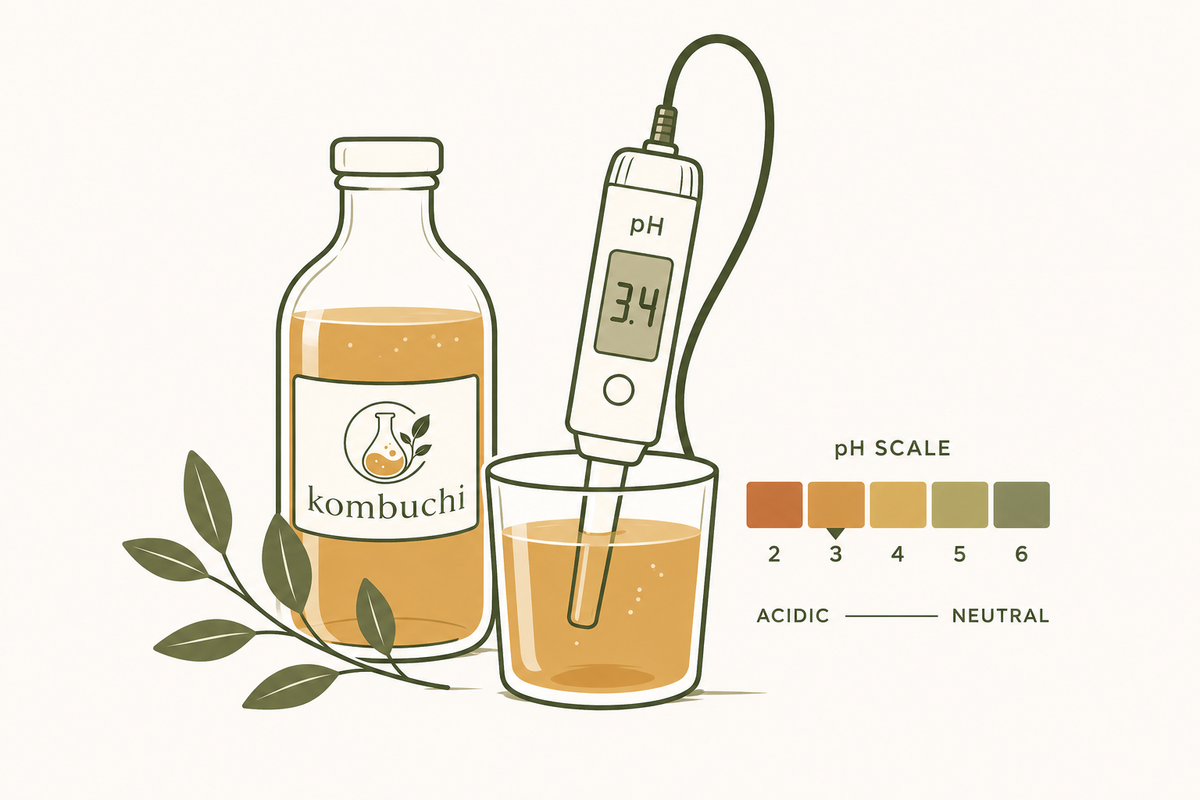
pH is a measure of acidity — specifically, the concentration of hydrogen ions in a liquid. The scale runs from 0 to 14:
- 0–6: Acidic (the lower the number, the more acidic)
- 7: Neutral (pure water)
- 8–14: Alkaline (or basic)
One thing worth knowing: the pH scale is logarithmic, not linear. A liquid with a pH of 3 is ten times more acidic than one with a pH of 4, and one hundred times more acidic than a pH of 5. Small changes in number represent big changes in chemistry. This is why a kombucha that drops from pH 4.5 to pH 3.5 has changed more dramatically than it might sound.
Why pH Matters in Kombucha
1. Safety
This is the most important one. Your SCOBY is a symbiotic culture of bacteria and yeast, and it does its best work — and keeps you safe — in an acidic environment. Harmful bacteria like E. coli and Salmonella cannot survive below a pH of around 4.0. A healthy kombucha ferment drops to this level quickly, creating a protective acid barrier.
The rule of thumb: your brew should reach a pH of 4.0 or below within the first few days. If it doesn't, something is wrong — either with your SCOBY, your temperature, or your starter liquid ratio — and you should investigate before drinking it.
This is why the pH of your starter liquid matters too. When you begin a new batch, adding acidic starter liquid (from a previous brew) immediately drops the pH of your sweet tea below 4.5. This fast acidification is your first line of defense against contamination. Never skip the starter liquid.
2. Flavor
Acidity and sourness are not the same thing — but they're closely related. As pH drops during fermentation, the acids produced by your bacteria give kombucha its characteristic tang. Different acids contribute different flavor notes:
- Acetic acid (also in vinegar): sharp, punchy sourness
- Lactic acid (also in yogurt): softer, rounder sourness
- Gluconic acid: mild, slightly fruity tartness
The lower the pH, the more these acids dominate the flavor. A finished kombucha at pH 3.0 will taste significantly more tart than one at pH 3.5. Understanding this relationship gives you real control over flavor — rather than just "brew for 7 days and see what happens."
3. Fermentation Health
pH is a live readout of what your SCOBY is doing. A healthy fermentation shows a predictable downward curve: pH starts around 4.0–4.5 (with starter liquid added), drops into the 3s within a few days, and stabilizes in the 2.5–3.5 range by the time you're ready to bottle.
If your pH isn't moving, your fermentation has stalled. If it drops too fast, your environment might be too warm or your starter ratio too high. Tracking pH over time gives you a window into the biology that no amount of tasting can replicate.
The pH Journey of a Typical Brew
Here's what a healthy first fermentation looks like over time, assuming proper starter liquid and a temperature around 75°F (24°C):
| Day | Typical pH Range | What's Happening |
|---|---|---|
| 0 (start) | 4.0 – 4.5 | Sweet tea + starter liquid combined. Protective acidification begins. |
| 1–2 | 3.8 – 4.2 | Yeast activity increases, CO₂ production begins |
| 3–4 | 3.4 – 3.8 | Bacterial activity ramps up, acetic and lactic acid production |
| 5–7 | 3.0 – 3.5 | Active fermentation, flavor developing rapidly |
| 8–10 | 2.8 – 3.2 | Fermentation slowing, flavor deepening |
| 12–14 | 2.5 – 3.0 | Brew approaching finished. Taste and decide. |
Note: These are guidelines, not rules. Temperature, SCOBY health, tea type, and sugar concentration all affect the curve. This is exactly why measuring is more reliable than following a fixed number of days.
How to Measure pH
Option 1: pH Test Strips
Pros: Cheap, no calibration needed, widely available. Cons: Imprecise (usually accurate to ±0.5 pH), can be hard to read accurately with dark-colored kombucha, and a 0.5 margin of error matters when you're working in the 2.5–3.5 range.
Strips are fine for a rough check — "is this brew acidic enough to be safe?" — but they're not sufficient if you want real precision or repeatable results.
Option 2: Digital pH Meter (Recommended)
Pros: Accurate to ±0.01–0.1 pH depending on the model, fast, easy to read. Cons: Requires calibration (simple, takes 2 minutes), probe needs care and storage in electrode solution.
For serious brewing, a digital meter is the tool. You don't need an expensive lab-grade instrument — a mid-range meter in the $30–$60 range is more than sufficient for homebrewing.
What to look for:
- Accuracy of ±0.1 pH or better
- Automatic Temperature Compensation (ATC) — kombucha temperature affects pH readings, and ATC corrects for this automatically
- Replaceable electrode (cheaper in the long run)
- Comes with calibration buffer solutions (pH 4.0 and 7.0)
Calibration tip: Calibrate your meter before each brewing session, not just when you remember. Electrodes drift over time, and an uncalibrated meter will give you false confidence.
Target pH Ranges at a Glance
| Stage | Target pH | Notes |
|---|---|---|
| Sweet tea before starter | 6.5 – 7.5 | Neutral to slightly acidic depending on tea type |
| After adding starter liquid | 4.0 – 4.5 | Must be at or below 4.5 before fermentation begins |
| Mid-fermentation (day 5–7) | 3.2 – 3.8 | Fermentation active, check every day or two |
| Finished first ferment | 2.5 – 3.5 | Taste here — pH 3.0–3.2 is a sweet spot for most |
| Too acidic / over-fermented | Below 2.5 | Still safe, but likely very vinegary in flavor |
| Under-fermented / concern zone | Above 4.0 | Investigate before consuming |
Troubleshooting with pH
pH isn't dropping after 3–4 days: Your fermentation has stalled. Common causes: temperature too low (below 65°F/18°C), starter liquid ratio too low, or an unhealthy SCOBY. Check your environment first — kombucha ferments best between 70–85°F (21–29°C).
pH dropped extremely fast (below 3.0 in 2–3 days): Your starter liquid ratio was likely too high, or your environment is very warm. Not dangerous, but you may end up with a more vinegary flavor than intended. Use less starter next batch.
pH is stuck above 3.5 at day 10+: Your SCOBY may be weak or your tea-to-sugar ratio is off. Check that you're using the right sugar quantity (typically 1 cup per gallon) and that your tea isn't too strong or too weak, as tannin levels affect fermentation.
pH reading seems inconsistent: Calibrate your meter. If the issue persists, your electrode may need replacement or storage solution.
Key Takeaways
| Topic | The Short Answer |
|---|---|
| What is pH? | A measure of acidity on a 0–14 scale. Lower = more acidic. |
| Why does it matter? | Safety, flavor control, and fermentation health — all in one number. |
| Starting pH | Must be at or below 4.5 after adding starter liquid. Never skip this check. |
| Finished pH | Aim for 2.5–3.5. pH 3.0–3.2 is the sweet spot for most palates. |
| Best measurement tool | Digital pH meter with ATC (~$30–$60). Calibrate before every session. |
| pH not dropping? | Check temperature (70–85°F), starter ratio, and SCOBY health. |
| pH dropping too fast? | Reduce starter liquid next batch, or lower ambient temperature. |
What Comes Next
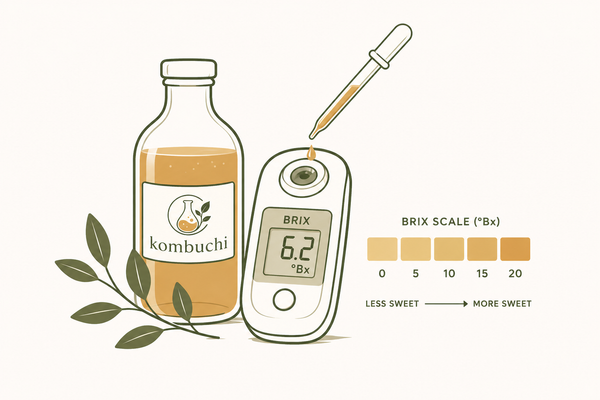
pH tells you how acidic your brew is — but it doesn't tell you how much sugar remains. For that, you need Brix measurement. Together, pH and Brix give you a complete picture of where your fermentation stands. We cover that in the next Science Corner article: What is Brix and Why Should Kombucha Brewers Care?
If you're already tracking pH and want to go deeper, read The Kombuchi Fermentation Curve — original data showing exactly how pH and Brix move together over a 14-day fermentation.
Have questions about your pH readings? Drop them in the comments. And if your SCOBY is looking particularly terrifying right now, you might have a submission for Scoby Scoby Doo →.
Kombuchi — Science Corner