What is Brix and Why Should Kombucha Brewers Care?
Science Corner | Beginner → Intermediate
TL;DR: Brix measures dissolved sugar content in your brew. As fermentation progresses, yeast consume sugar and your Brix reading drops. Where pH tells you how acidic your kombucha is, Brix tells you how sweet it still is. Together, they give you the complete picture. A refractometer is all you need — and a decent one costs less than $25.
You've got pH dialed in. You know your brew is acidifying properly and your SCOBY is doing its job. But here's what pH doesn't tell you: how much sugar is left. Is your kombucha still sweet and barely fermented, or is it almost dry? Has the yeast actually been working, or is something stalling out?
That's the gap Brix fills. And once you start tracking both numbers together, you stop guessing entirely.
What is Brix?
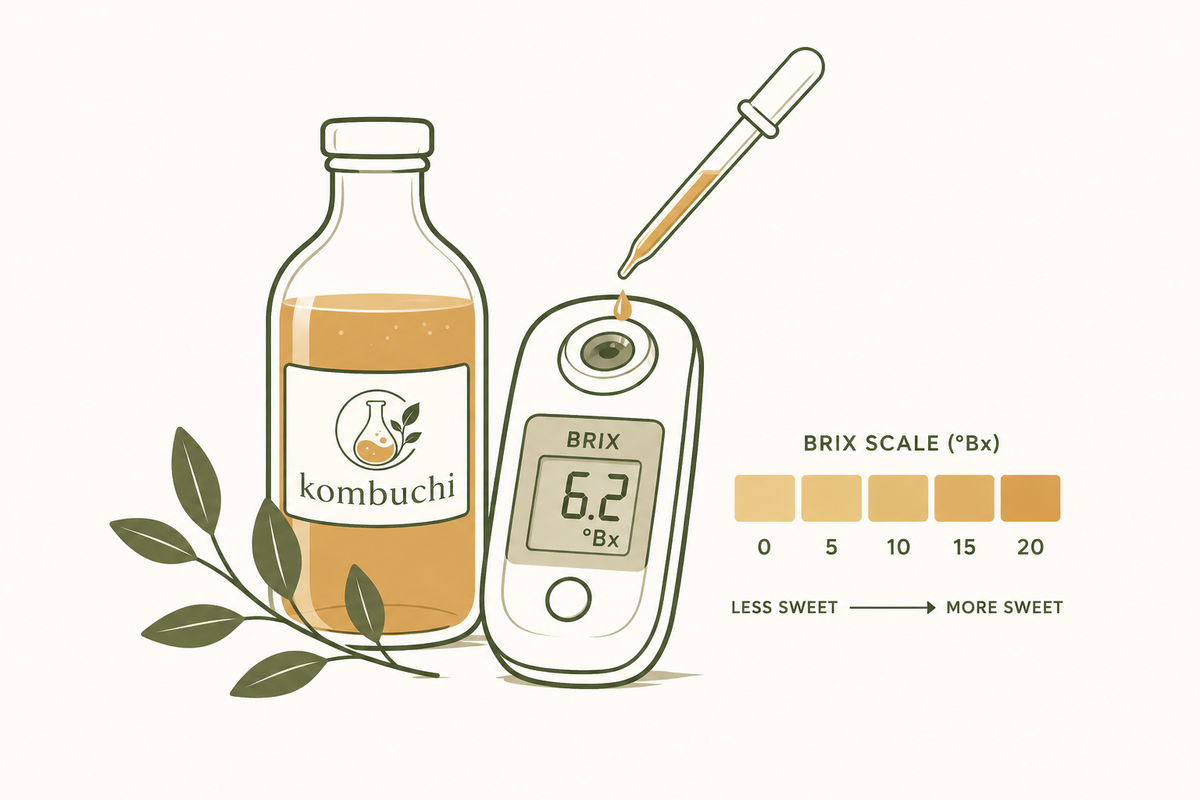
Brix (°Bx) is a measure of dissolved solids in a liquid — in the context of brewing, that's primarily sugar. One degree Brix equals one gram of sucrose per 100 grams of solution. Put simply: a liquid reading 8°Bx is roughly 8% sugar by weight.
The scale was developed in the 19th century by Adolf Brix, a German scientist, and has been used in the winemaking, craft beer, and juice industries for decades. Kombucha brewers are relative newcomers to using it — which is exactly why tracking it gives you an edge.
Why Brix Matters in Kombucha
1. It Tracks Fermentation Progress
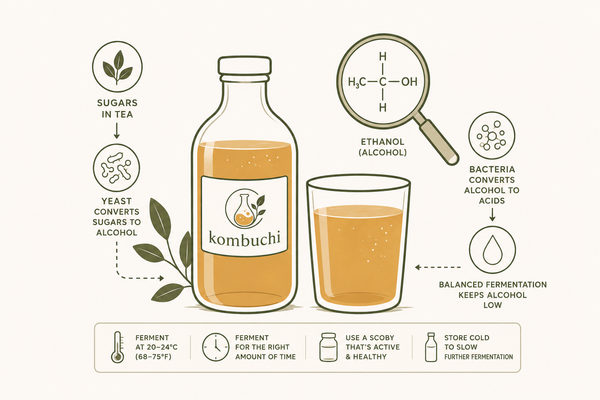
When you make sweet tea for kombucha, you're dissolving sugar into water — that's your starting Brix. As fermentation begins, yeast convert that sugar into alcohol and CO₂, and bacteria convert byproducts into organic acids. The sugar content drops. Your Brix reading drops with it.
A declining Brix reading is confirmation that fermentation is actually happening. A Brix reading that isn't moving is a red flag — even if everything looks fine on the surface.
2. It Tells You How Much Sweetness Remains
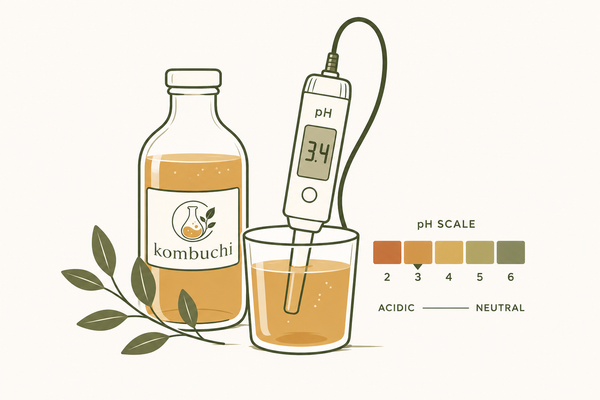
pH tells you about acidity. Brix tells you about residual sweetness. A finished kombucha with a pH of 3.2 and a Brix of 6°Bx will taste noticeably sweeter than one at the same pH but 2°Bx. Understanding both numbers lets you bottle at exactly the right moment for your target flavor profile — rather than relying on taste alone, which varies day to day and person to person.
3. It Helps with Second Ferment Timing
Residual sugar at the end of first ferment is what drives carbonation in the bottle during second ferment. Too much sugar left over means excessive carbonation and the risk of over-pressurized bottles. Too little means flat, disappointing results. Brix measurement gives you a consistent benchmark for knowing when you're in the right window to bottle — every single batch.
4. It Builds Batch Consistency
One of the hardest things about homebrewing is reproducing results. With Brix, you can document exactly where your brew started and where it finished. Over time, you build a personal data set that tells you how your SCOBY, in your environment, performs across batches. That's how you go from "this one turned out well" to knowing exactly why.
How to Measure Brix
The Refractometer
Brix is measured with a refractometer — a small handheld device that uses the way light bends through a liquid to determine its sugar content. You place a few drops of liquid on the prism, hold it up to a light source, and read the scale.
Analog refractometer (~$15–25): Simple, reliable, no batteries. You read a scale through an eyepiece. Accuracy is typically ±0.2°Bx, which is more than sufficient for homebrewing. This is the tool most kombucha brewers need.
Digital refractometer (~$40–80): Easier to read, slightly more precise. Good if you're doing high-frequency testing across multiple batches simultaneously.
What to look for:
- ATC (Automatic Temperature Compensation) — liquid temperature affects light refraction, and ATC corrects for this automatically. Worth having.
- A Brix range of 0–32°Bx is plenty for kombucha (you'll never exceed 15°Bx at the start)
- Calibrate with distilled water before use — it should read exactly 0°Bx
One Important Caveat
Refractometers are calibrated for sucrose dissolved in water. As fermentation progresses, alcohol and other compounds enter the liquid and affect how light bends — which means Brix readings become less precise in the later stages of fermentation. This doesn't make the tool useless; it means you should read Brix comparatively (is it dropping?) rather than as a perfectly literal sugar percentage mid-brew. For starting Brix and early fermentation tracking, the readings are highly reliable.
The Brix Journey of a Typical Brew
Here's what a healthy first fermentation looks like over time, starting with 1 cup of sugar per gallon of tea at 75°F (24°C):
| Day | Typical Brix Range | What's Happening |
|---|---|---|
| 0 (start) | 6 – 10°Bx | Sweet tea baseline. Your starting point for the batch. |
| 1–2 | 6 – 9°Bx | Yeast activating, minimal sugar consumption yet |
| 3–5 | 5 – 8°Bx | Yeast in full swing, sugar consumption accelerating |
| 6–8 | 4 – 6°Bx | Active fermentation, Brix dropping steadily |
| 9–11 | 3 – 5°Bx | Fermentation slowing, approaching finish |
| 12–14 | 2 – 4°Bx | Brew nearing completion. Cross-check with pH and taste. |
Note: Starting Brix depends directly on how much sugar you use. More sugar = higher starting Brix = longer fermentation. Tracking your starting Brix lets you adjust sugar quantities intentionally across batches.
Reading Brix and pH Together
This is where the real power comes in. Neither measurement alone tells the full story — but together, they tell you almost everything:
| pH | Brix | What It Means |
|---|---|---|
| High (>4.0) | High (>7°Bx) | Early fermentation or stalled. Investigate. |
| Dropping | Dropping | Healthy, active fermentation. You're on track. |
| Low (2.5–3.5) | Medium (4–6°Bx) | Well-fermented, some residual sweetness. Classic kombucha. |
| Low (2.5–3.5) | Low (<3°Bx) | Dry, very tart. Consider bottling sooner next batch. |
| Low (<2.5) | Low (<2°Bx) | Over-fermented. Still safe, but will taste vinegary. |
Target Brix Ranges at a Glance
| Stage | Target Brix | Notes |
|---|---|---|
| Starting sweet tea | 6 – 10°Bx | Depends on sugar quantity. Document this every batch. |
| Mid-fermentation (day 5–7) | 4 – 7°Bx | Should be clearly lower than starting point |
| Ready to bottle (first ferment end) | 2 – 5°Bx | Cross-check with pH 2.5–3.5 and taste |
| Ideal for second ferment carbonation | 3 – 5°Bx | Enough residual sugar to carbonate without over-pressurizing |
| Too low for second ferment | Below 2°Bx | May result in flat bottles — add a small amount of sugar or juice |
Troubleshooting with Brix
Brix isn't dropping after 3–4 days: Your fermentation has stalled. Cross-check with pH — if pH also isn't moving, your SCOBY isn't active. Check temperature, starter liquid ratio, and SCOBY health. Same root causes as a stalled pH curve.
Brix is dropping but pH isn't moving much: Yeast are active (consuming sugar) but bacterial activity is low. Usually a temperature issue — bacteria prefer slightly warmer conditions than yeast. Try moving your brew somewhere warmer.
Starting Brix varies batch to batch: You're probably not measuring your sugar consistently. Use a kitchen scale instead of volume cups — 200 grams of sugar every time, regardless of granule size or packing.
Bottles are over-carbonating (too much pressure): Your Brix at bottling was too high. More residual sugar means more CO₂ produced during second ferment. Aim to bottle when Brix is below 5°Bx, and burp your bottles daily during second ferment.
Bottles are flat: Either Brix was too low at bottling, your second ferment temperature was too cold, or your bottles aren't sealing properly. Check all three.
Key Takeaways
| Topic | The Short Answer |
|---|---|
| What is Brix? | A measure of dissolved sugar content. Lower = less sugar remaining. |
| Why does it matter? | Tracks fermentation progress, residual sweetness, and second ferment readiness. |
| Best tool | Analog refractometer with ATC (~$15–25). Calibrate with distilled water. |
| Starting Brix | Typically 6–10°Bx depending on sugar quantity. Document every batch. |
| Finished first ferment | Aim for 2–5°Bx. Cross-check with pH and taste before bottling. |
| Brix not dropping? | Fermentation stalled. Check temperature, starter ratio, SCOBY health. |
| Bottles over-carbonating? | Brix at bottling was too high. Bottle below 5°Bx next time. |
| Use with pH? | Always. Brix + pH together tell you everything pH or Brix alone cannot. |
What Comes Next
You're now tracking both acidity and sugar content across your fermentation. The natural next step is understanding how these two measurements move together — and what the data looks like across a full 14-day brew. That's exactly what we document in The Kombuchi Fermentation Curve, where we chart real pH and Brix readings day by day so you know precisely what a healthy fermentation looks like at every stage.
Tracking your own Brix numbers? Share your starting and finishing readings in the comments — we're building a community data set. And if your SCOBY looks like it belongs in a horror film, submit it to Scoby Scoby Doo →.
Kombuchi — Science Corner